What Is the “CR” Stamp on LinkedIn Images?Content Credentials
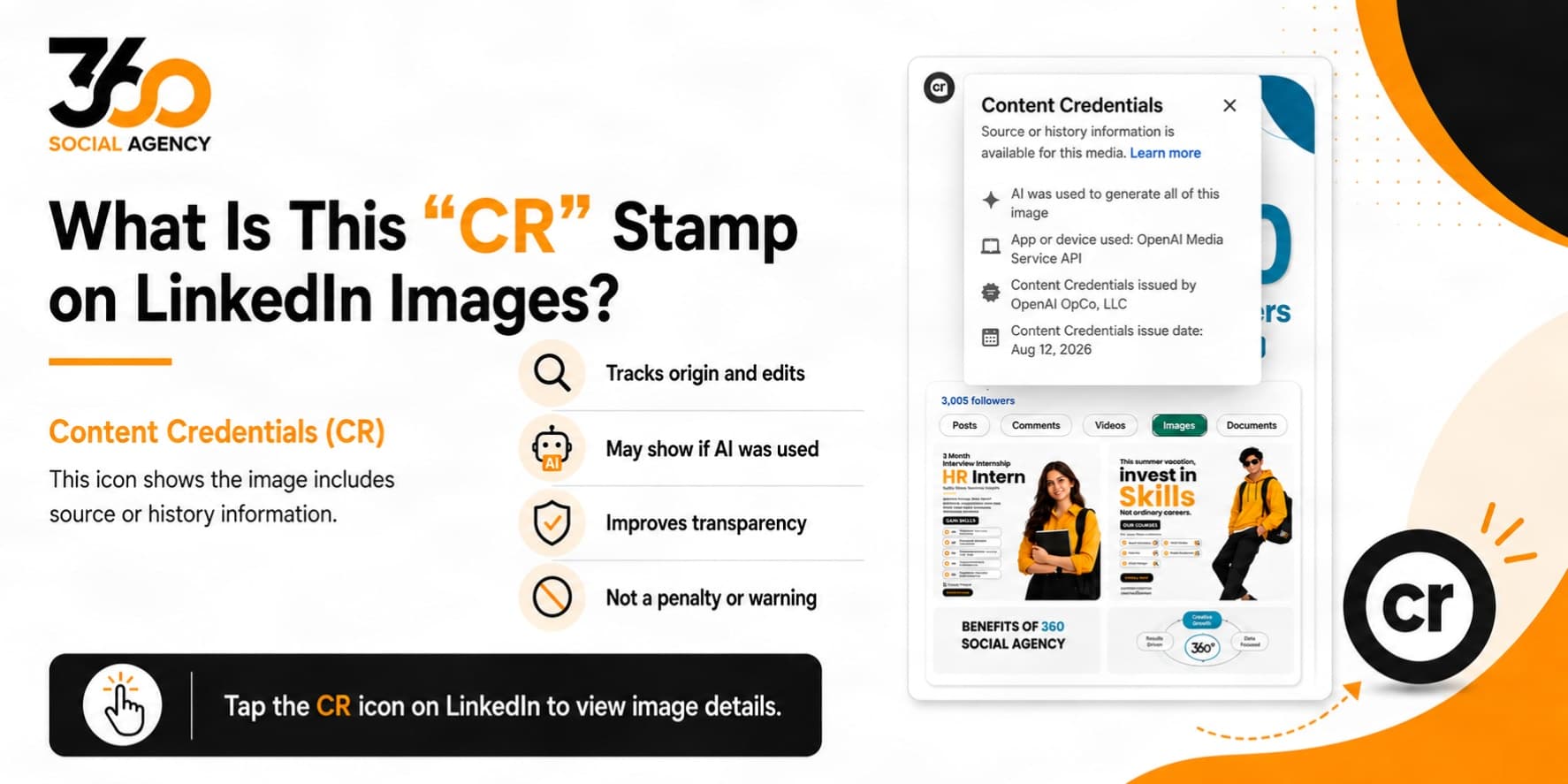
If you have recently noticed a small “CR” icon on LinkedIn images, you may have wondered what it means and why it appears only on certain posts. For many users, the first assumption is that LinkedIn has flagged the image, detected AI-generated content, or applied some kind of restriction. In reality, the CR icon is not a warning label. It is connected to Content Credentials, a system designed to provide more transparency about the origin and editing history of digital media.
As AI-generated images become more common on LinkedIn, Instagram, websites, and advertising campaigns, platforms are beginning to give users more information about how digital content was produced. LinkedIn now supports the C2PA standard, which allows compatible images and videos to carry information about their source, creation process, and editing history. For businesses already using AI in social media content creation, understanding Content Credentials is becoming increasingly important.
What Does the CR Stamp on LinkedIn Mean?
The CR symbol represents Content Credentials. When LinkedIn detects supported provenance information inside or associated with an image, it may display the CR icon so viewers can access more details about that content.
According to LinkedIn’s official information about Content Credentials on LinkedIn, users may be able to see information about how an image or video was created. Depending on the file and the tool used to produce it, the information may show whether generative AI was involved, which application or service created the media, who issued the credentials, and when those credentials were generated.
It is helpful to think of the CR icon as an information label. It tells viewers that additional source or history information is available. It does not automatically mean that the image is fake, misleading, restricted, or against LinkedIn’s policies.
For marketers, designers, agencies, and businesses, this is an important distinction. AI is now used throughout the content creation process, from generating backgrounds and illustrations to editing photographs, creating advertisements, and developing social media graphics. The presence of a CR icon may simply reflect that one of the tools used during production supports Content Credentials.
What Are Content Credentials?
Content Credentials are designed to provide a record of how digital media was created and modified. They can help users understand where an image came from and what happened to it before it was published.
A simple way to understand Content Credentials is to think of them as a digital history card for an image. Instead of seeing only the final visual, a viewer may also receive information about the tools, services, or processes involved in producing it.
For example, a designer might begin with a photograph, use an AI tool to replace the background, adjust the lighting in editing software, add typography and branding, and then export the final design for LinkedIn. Content Credentials can provide additional context about parts of that process.
This is becoming especially relevant as AI-generated content improves. In many cases, it is no longer easy to determine whether an image was created by a camera, an AI model, a designer, or a combination of all three just by looking at it. Content Credentials provide another layer of information that can help viewers better understand what they are seeing.
What Is C2PA and Why Is It Important?
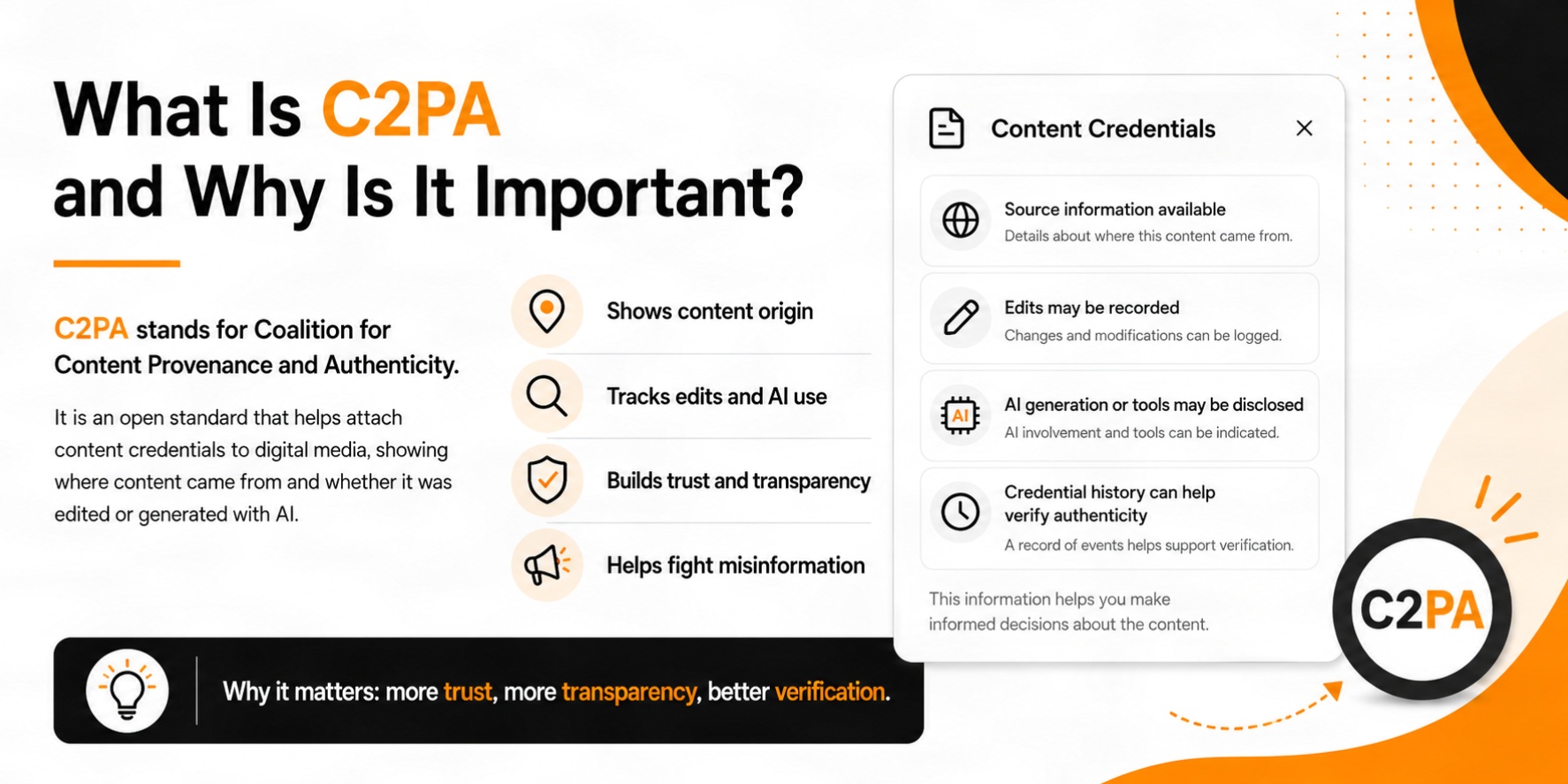
C2PA stands for the Coalition for Content Provenance and Authenticity. The organization develops an open technical standard for providing verifiable information about the origin and history of digital content.
The C2PA standard focuses on content provenance. In simple terms, provenance means knowing where a piece of content came from and what changes were made to it over time.
This is important because modern content can move through many different tools before reaching social media. A single image may be photographed on a phone, edited in Photoshop, modified using generative AI, resized in a design application, and then published on LinkedIn.
Without additional information, the viewer only sees the final result. C2PA and Content Credentials aim to provide more context about that journey.
For marketers, the growing adoption of these standards means that transparency will increasingly become part of digital publishing. Instead of treating AI usage as something that automatically needs to be hidden, businesses can focus on using AI responsibly while still maintaining high standards of creativity and accuracy.
Why Is LinkedIn Showing the CR Icon?
LinkedIn displays the CR icon when it recognizes compatible Content Credentials attached to or associated with an image or video.
When a user clicks the icon, LinkedIn may show a panel containing information about the content. This can include whether AI was involved, which application or device was used, the credential issuer, and the date the credential was created.
For example, an AI-generated image may contain information showing that a generative AI service was used during production. In another case, a photograph may contain information showing that it was edited using a particular creative application.
Not every image will display the same information because Content Credentials depend on the software, export settings, and production workflow used to create the media.
The broader purpose is transparency. LinkedIn is giving users the ability to see more information about digital content instead of forcing them to rely only on visual appearance.
Businesses that regularly publish professional content should therefore understand how the tools they use handle AI disclosure and provenance. This is especially relevant for companies investing in social media marketing, where visual content plays a major role in brand communication and audience engagement.
Is the CR Stamp a LinkedIn Penalty?
One of the most common concerns is whether the CR icon means LinkedIn has penalized a post.
The answer is no. The presence of the CR stamp does not automatically mean the post has been flagged, restricted, or penalized.
LinkedIn presents Content Credentials as an informational feature that helps users understand the origin and history of supported media. The icon itself is not described as a violation warning or reach penalty.
This is important because many businesses now use AI-assisted tools as part of their normal marketing workflow. A designer might use AI to generate a visual concept and then manually refine it before publication. If the final image contains Content Credentials, LinkedIn may display the CR icon even though the content is completely legitimate.
Instead of worrying about the icon, businesses should focus on the factors that actually influence content performance. These include strong messaging, useful information, attractive design, audience relevance, consistent posting, and proper content strategy.
A well-designed AI-assisted post can still perform effectively if it delivers value to the audience.
Why Do AI-Generated Images Often Show the CR Stamp?
AI-generated images are one of the main reasons Content Credentials are becoming more visible.
Many modern creative platforms are introducing provenance systems that record whether generative AI was used. For example, Adobe Content Credentials can provide information about how a piece of content was created or edited.
This does not necessarily mean that an entire image was generated automatically.
A designer may use AI only for one part of the visual. For example, AI could be used to create a background, remove an object, enhance an image, or generate a concept. The designer may then manually add text, colors, layouts, logos, and brand elements.
Modern creative production is often a combination of human and AI input.
For businesses, the important question is not simply whether AI was used. The more important question is whether the final content is accurate, professional, original, and useful.
The same principle applies to written content. AI can support research, ideation, and content development, but human review remains important. Our guide on creating SEO-friendly content using AI explains how businesses can combine AI with human editing to produce better results.
Are Content Credentials the Same as Normal Image Metadata?
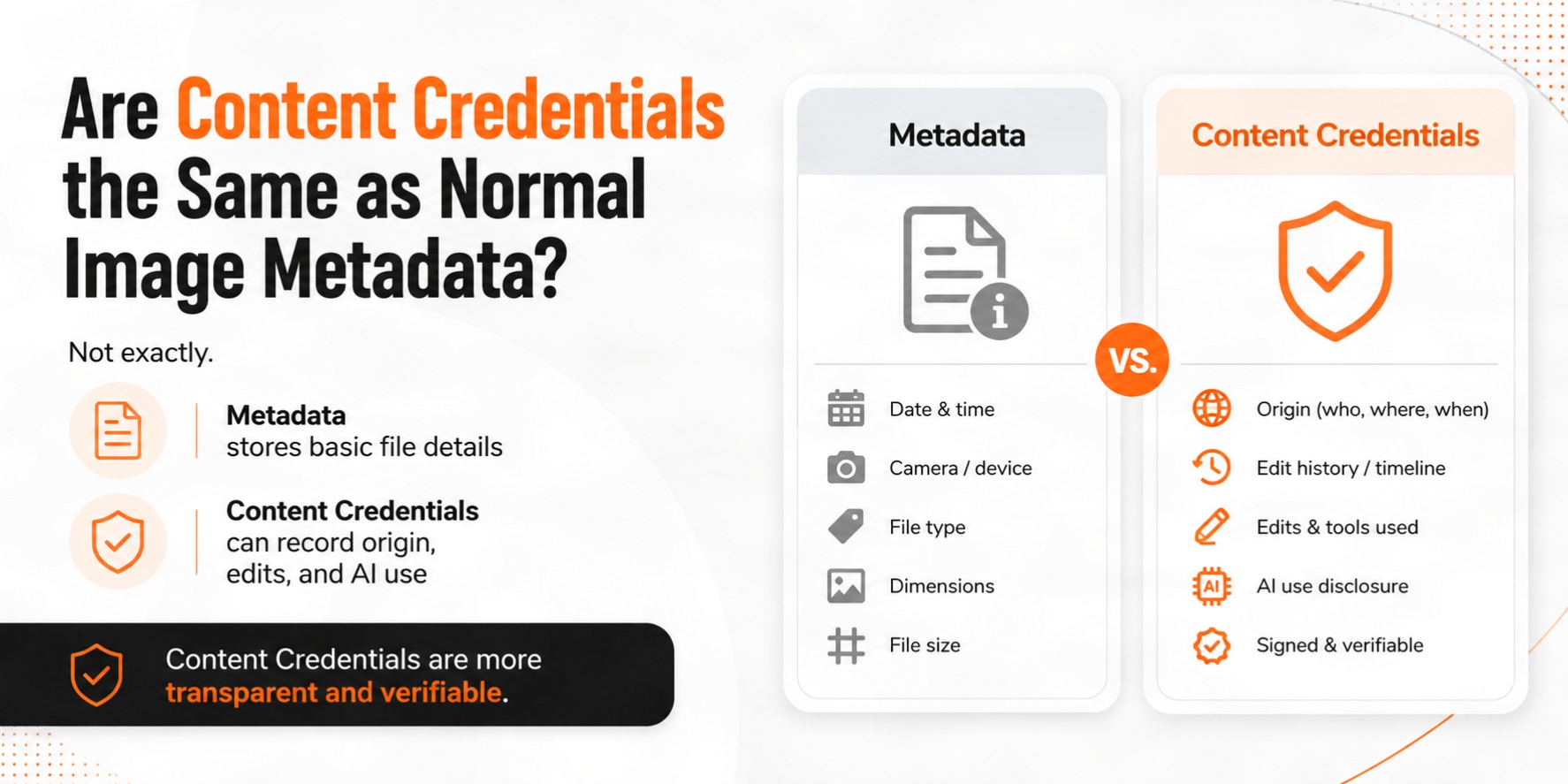
Content Credentials and normal image metadata are related, but they are not exactly the same.
Traditional metadata can include information such as the camera model, image dimensions, date created, GPS location, copyright information, and editing software. This type of information is commonly stored in EXIF or similar metadata fields.
Content Credentials are more focused on provenance and authenticity. They can include signed information about how a digital asset was created or changed.
This distinction matters because some people assume that changing ordinary metadata will automatically remove every type of provenance information.
That is not always the case.
Modern Content Credentials systems can use more advanced methods than standard EXIF metadata. Depending on the implementation, provenance information may remain available even when some basic metadata is removed.
For businesses, the better approach is to understand the tools being used rather than trying to manipulate file information without knowing how the underlying credential system works.
Can Changing Image Metadata Remove the CR Stamp?
Changing ordinary image metadata may affect some file information, but it should not be considered a guaranteed way to control Content Credentials.
Different tools can handle provenance information differently. Some credentials may be embedded directly in the file, while others may be associated with the media through additional verification systems.
Adobe, for example, explains that its Content Credentials management system can use different methods to help maintain or recover provenance information.
Because these technologies are developing rapidly, simply changing a few metadata fields is not a reliable long-term strategy.
Businesses should also avoid deliberately altering provenance information for the purpose of making AI-generated content appear as though AI was never involved.
Transparency is becoming increasingly important in digital marketing, and audiences are becoming more comfortable with AI-assisted content when it is used responsibly.
What About Removing Metadata for Privacy?
There are legitimate reasons to remove certain types of image metadata.
For example, photographs taken with smartphones or cameras may contain GPS coordinates, timestamps, camera details, or other private information. Businesses may want to remove this data before publishing images online.
Removing unnecessary private metadata is a sensible privacy practice.
However, there is a difference between protecting private information and intentionally misrepresenting the origin of content.
A company may reasonably remove GPS information from a photograph while still allowing provenance information about the editing or creation process to remain accurate.
This creates a better balance between privacy and transparency.
Will Cropping, Resizing, or Re-Exporting Remove Content Credentials?
There is no universal answer.
The result depends on the software being used, how the image is exported, the file format, and how the credentials are stored.
In some workflows, certain information may be preserved. In others, the editing process may create a new provenance record. Some applications may remove specific metadata fields while other systems may still be able to recognize the asset’s history.
Because of this, businesses should not rely on simple tricks such as cropping, resizing, or re-exporting images as a permanent way to remove Content Credentials.
The technology behind provenance is continuing to improve, and different platforms may handle the same image differently.
A better approach is to focus on creating content that you are comfortable publishing regardless of whether provenance information is visible.
Should Businesses Stop Using AI Images on LinkedIn?
Absolutely not.
AI can be a powerful tool for businesses when it is used correctly. It can help teams create visual concepts faster, generate creative ideas, improve productivity, and produce content at scale.
The problem is not AI itself. The real issue is low-quality AI content.
A poorly generated image with incorrect text, unrealistic details, weak typography, and inconsistent branding can damage a company’s professional image.
On the other hand, an AI-assisted visual that has been reviewed, edited, and aligned with the brand can be highly effective.
Businesses should treat AI as a creative tool rather than a replacement for strategy.
Professional digital marketing services combine content strategy, design, SEO, advertising, branding, and audience research. AI can support these areas, but the final decisions should still be guided by human experience and business goals.
Why Content Transparency Matters for Digital Marketing
The growth of AI is changing how audiences evaluate digital content.
People increasingly want to know whether a visual is authentic, edited, AI-generated, or manipulated. Content Credentials are one way of providing that information.
For marketers, this creates both a responsibility and an opportunity.
The responsibility is to make sure that AI-generated content is accurate, useful, and professionally reviewed.
The opportunity is that brands can use AI to work faster without sacrificing trust.
Businesses that use AI transparently and responsibly may actually strengthen their reputation. Instead of trying to hide the tools used in the creative process, they can focus on producing content that delivers real value.
Trust has always been an important part of digital marketing. Content Credentials simply provide another way for platforms and users to understand how media is created.
Best Practices for Businesses Using AI-Generated Content
Businesses using AI-generated images should create a proper review process before publishing content.
Every visual should be checked carefully for mistakes. AI-generated images can sometimes contain incorrect text, unrealistic hands, distorted faces, inaccurate product details, or inconsistent logos.
The final visual should also match the company’s brand identity. Fonts, colors, typography, tone, messaging, and layout should remain consistent across different social media platforms.
Businesses should also verify any factual information included in AI-generated graphics. AI tools can make mistakes, so claims, statistics, names, and dates should always be reviewed.
The same approach should be used for written content. AI can help produce ideas and drafts, but businesses should still improve readability, add original insights, verify information, and make sure the final article matches search intent.
For companies that want a complete strategy across social media, SEO, paid advertising, content creation, branding, and website development, 360 Social Agency provides integrated digital marketing solutions designed to help brands build a stronger online presence.
Final Thoughts
The CR stamp on LinkedIn images is not something businesses need to fear. It represents Content Credentials, a transparency system that helps users understand the origin and history of digital media.
When LinkedIn detects supported C2PA information, it may display the CR icon and allow viewers to see details about how the image or video was created. This can include information about AI involvement, software, devices, credential issuers, and creation dates.
Most importantly, the CR icon itself should not automatically be interpreted as a LinkedIn penalty or warning.
As AI becomes a normal part of digital marketing, transparency features like Content Credentials are likely to become more common. Businesses that understand these systems will be better prepared to use AI responsibly while maintaining trust with their audiences.
Instead of focusing on hiding how content was created, brands should focus on creating visuals and messages that are useful, accurate, engaging, and aligned with their identity.
AI can speed up content production, but strategy, creativity, quality control, and human judgment will continue to determine whether that content actually succeeds.
For businesses looking to improve their online presence through content, SEO, social media, paid advertising, or branding, 360 Social Agency can help develop a complete digital strategy focused on sustainable growth.
Frequently asked questions
The CR stamp stands for Content Credentials. It indicates that additional information may be available about how an image was created, edited, or processed.
No. The CR icon itself does not mean your post has been flagged, restricted, or penalized. It is mainly used to provide transparency about the image’s origin and history.
Some AI tools attach Content Credentials when generating or editing images. If LinkedIn detects this information, it may display the CR icon on the image.
Changing basic metadata does not guarantee that Content Credentials will disappear. C2PA-based provenance information can work differently from normal EXIF or file metadata.
No. Businesses can still use AI-generated or AI-assisted visuals. The key is to review the final content carefully, maintain brand quality, and use AI responsibly.
Want us to do this for you?
Get a free, no-pressure audit of your ads, funnel, and website.
Get my free audit