Social Media Content Creation: A Practical Guide
Creating content for social media sounds easy until you actually have to do it every week. At first, you may have plenty of ideas, but over time, engagement can slow down, topics may start feeling repetitive, and social media becomes another unfinished task on your list.
This is where a proper social media content creation process makes a real difference. Instead of publishing random posts whenever inspiration strikes, successful brands create content around clear goals, audience interests, useful topics, and a realistic posting schedule.
The purpose is not simply to stay active online. It is to make your brand easier to notice, understand, remember, and trust.
For entrepreneurs, startups, personal brands, marketing teams, and small or medium-sized businesses, the right content system can turn social media from a daily headache into a valuable marketing channel.
What Does Social Media Content Creation Actually Mean?
Social media content creation is the complete process of developing content for social platforms, from the first idea to the final published post. It includes deciding what to talk about, choosing a suitable format, writing the message, creating visuals, publishing the post, and reviewing how people respond.
A piece of social content can take many forms. It could be an Instagram Reel explaining a common customer problem, a LinkedIn post sharing an industry lesson, a carousel teaching a simple process, a product video, a founder story, a poll, or even a customer testimonial.
The format may change, but good content usually has one thing in common: it gives the audience something worth paying attention to. Businesses often make the mistake of treating social media like a digital notice board by publishing only discounts, product photos, company updates, and promotional messages.
That may keep an account active, but activity alone does not build interest. Effective content should answer a useful question, solve a small problem, create curiosity, teach something valuable, or start a relevant conversation.
Start With a Clear Social Media Content Strategy
Posting without direction usually creates inconsistent results. Before designing graphics or writing captions, you need a social media content strategy that connects your content with an actual business goal.
Start by identifying what you want social media to achieve. Your goal may be brand awareness, lead generation, website traffic, personal brand growth, local visibility, service promotion, or support for a new product launch.
Your objective influences the type of content you should create. A business trying to build authority may focus on educational posts, case studies, expert insights, and industry opinions, while an e-commerce brand may rely more on product demonstrations, customer reviews, short videos, and user-generated content.
Your audience should also shape your strategy. Instead of thinking broadly about "customers," think about the exact person you want to reach and understand their problems, goals, questions, buying concerns, and expectations.
A useful social media content strategy should also include a few main content themes, often called content pillars. A marketing company, for example, could focus on educational tips, common mistakes, client results, behind-the-scenes content, industry insights, and service-related posts.
Once these themes are defined, creating new content becomes easier because every post has a clear role within your wider strategy.
Find Social Media Content Ideas in Real Conversations
Many businesses believe they have an idea problem, but most of the time, the real issue is that they are not paying enough attention to their audience. Some of the best social media content ideas are already hidden inside conversations your business has every day.
Check the questions customers send by email, review direct messages, listen during sales calls, and pay attention to comments under your posts. Every repeated question can potentially become a useful piece of content.
For example, imagine you run a web design business and prospects often ask how much a professional website costs. That single question could become an Instagram Reel, a LinkedIn post, a carousel, a short video, and even a detailed blog article.
You do not always need a completely new idea. Often, you simply need a new way to present an existing idea.
This approach makes social media content planning easier because one useful topic can be turned into multiple formats. You can also create content around mistakes, myths, comparisons, checklists, customer questions, industry trends, before-and-after examples, case studies, personal lessons, and unpopular opinions.
The strongest topics are usually specific. "Marketing tips for businesses" is broad, while "Three reasons your Instagram posts get views but no enquiries" gives the audience a much clearer reason to pay attention.
Use Different Types of Social Media Content
Your audience will not always want to consume information in the same way. That is why businesses should experiment with different types of social media content instead of depending on one format all the time.
Short-form videos work well when you want to explain an idea quickly or capture attention within the first few seconds. Carousels are useful for breaking complex information into easy steps, while single-image posts can work well for statistics, announcements, bold statements, and quick tips.
Customer testimonials can help build trust by showing that real people have already experienced your product or service. Behind-the-scenes content can make your brand feel more personal, while educational posts can demonstrate expertise without directly asking someone to buy.
The right format depends on your audience, platform, and message. A professional LinkedIn audience may respond well to industry insights and experience-based posts, while an Instagram audience may prefer short videos, visual carousels, and relatable content.
Do not assume one format will always perform best. Test different content styles and pay attention to what people actually save, share, watch, comment on, and respond to.
Make Social Media Content Planning Easier
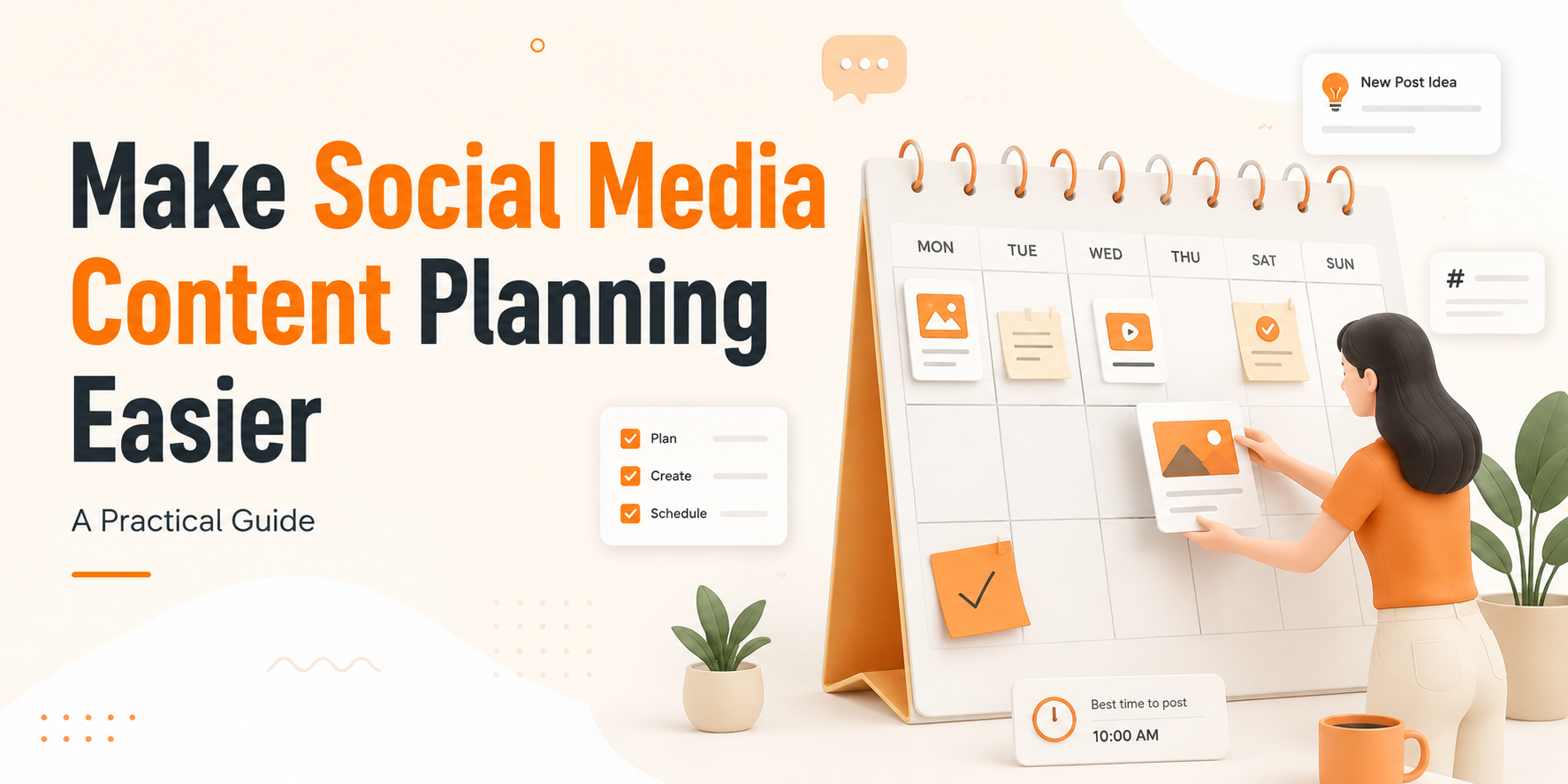
One of the biggest reasons businesses become inconsistent on social media is that they plan too late. If you wait until the day of publishing to decide what to post, social media will always compete with more urgent business tasks.
Good social media content planning removes much of that pressure. Instead of asking yourself what to publish every morning, decide your topics in advance and create a realistic system around them.
Start by deciding how many posts your team can genuinely create each week. There is no benefit in planning seven posts if you can only produce three properly.
Quality and consistency are more valuable than an ambitious schedule that disappears after two weeks. Once you know your posting frequency, distribute your content pillars across the month.
For example, you may publish an educational post early in the week, a customer story in the middle of the week, and a lighter video or opinion post toward the weekend. This creates variety while keeping the process simple and manageable.
Planning in advance also gives your designer, copywriter, video editor, or marketing team enough time to create stronger work. Instead of rushing to complete content on the same day, everyone knows what is coming next.
Build a Social Media Content Calendar
Once your topics are planned, organize them inside a social media content calendar. A content calendar acts as one central place where you can see what is being created, when it will be published, and what purpose it serves.
Your calendar does not have to be complicated. A simple spreadsheet can include the publishing date, platform, topic, content format, main message, call to action, design status, and publishing status.
For many small businesses, that is more than enough. The goal is not to create a complicated system but to make your content process easier to manage.
A good social media content calendar also helps prevent repetition. When you can see the entire month at once, it becomes easier to notice if you have published too much promotional content and not enough educational, engaging, or trust-building content.
Content calendars are also useful for campaigns. If you are launching a product, you can organize teaser posts, educational content, customer proof, launch announcements, and follow-up posts in the right order.
Instead of publishing unrelated updates, your content starts working together as part of one bigger campaign.
Make Every Post Easy to Understand
People scroll quickly, and if your message takes too long to understand, they may never reach the important part. Successful social media content creation depends heavily on clarity.
Start with an opening that immediately gives the reader a reason to continue. Instead of writing, "Our company provides professional social media marketing solutions," you could say, "Posting consistently but still getting no enquiries?"
The second version connects directly with a problem the reader may already be experiencing. Once you have their attention, deliver the value quickly without unnecessary jargon or complicated wording.
Your visuals should follow the same principle. A design does not need ten different elements to look professional.
Clear typography, enough white space, readable text, consistent brand colors, and one strong message can often create a better result than a design filled with too much information.
People should understand the purpose of your post within a few seconds.
Stop Selling in Every Single Post
Social media users do not open Instagram, Facebook, LinkedIn, or TikTok because they want to see advertisements all day. If every post says "Buy now," "Book today," or "Contact us," your audience may quickly stop paying attention.
A better approach is to earn attention before asking for action. Teach something helpful, share an experience, explain a common mistake, answer a customer question, show how something works, or tell a real story.
Once you have delivered value, you can naturally introduce your service or product where it makes sense. This balance helps your business become useful instead of constantly promotional.
Useful brands are easier to remember, and remembered brands are far more likely to be considered when someone is ready to buy.
When Social Media Content Creation Services Make Sense
Managing social media properly can require several skills at once. Someone needs to research topics, build the strategy, write captions, design graphics, edit videos, schedule posts, review analytics, and maintain brand consistency.
For a business owner managing customers, employees, operations, and sales at the same time, this workload can quickly become difficult to maintain. That is where professional social media content creation services can help.
A capable social media content creation agency should do more than simply create attractive graphics. The agency should understand your audience, business goals, brand voice, content themes, and wider marketing direction.
Professional social media content services can include content strategy, planning, copywriting, graphic design, video editing, scheduling, campaign creation, and performance analysis.
Working with a social media content marketing agency can also help businesses remain consistent when they do not have a complete in-house marketing team. The main value is not simply having someone publish posts for you.
It is having a reliable content system that continues working even when your own schedule becomes busy.
Measure What Your Audience Actually Does
Content creation should not end when you press publish. The next important step is understanding how people respond and using that information to improve future posts.
Likes can be helpful, but they do not tell the full story. Pay attention to saves, shares, comments, watch time, profile visits, website clicks, enquiries, and conversions.
A post with fewer likes but several qualified enquiries can be far more valuable than a post with hundreds of likes and no business impact.
Review your strongest posts regularly and look for patterns. Check which topics performed well, what type of opening you used, which format worked best, and whether the content was educational, personal, promotional, or entertaining.
Over time, these patterns will help you understand what your audience actually wants. Use those insights to improve your next month of content instead of guessing.
Final Thoughts
Great social media content creation is not about filling a feed with as many posts as possible. It is about building meaningful communication between your brand and the people you want to reach.
Start with a clear strategy, understand your audience, choose useful topics, experiment with different types of social media content, and organize everything through effective social media content planning.
A well-structured social media content calendar can help you stay consistent, reduce last-minute stress, and create a better balance between educational, engaging, and promotional content.
Most importantly, focus on creating content that deserves attention. When your posts repeatedly help people learn, solve problems, make decisions, or understand your business better, your brand becomes easier to remember and trust.
You do not need every post to go viral. You need the right people to keep noticing your business.
Need Help Creating Content Consistently?
If social media keeps getting pushed to the bottom of your to-do list, professional support can make the process much easier. Our social media content creation services help businesses, startups, entrepreneurs, and personal brands create content that supports their marketing goals and reflects their brand identity.
Instead of spending hours deciding what to post next, you can focus on running and growing your business while your social media presence stays active and consistent.
Book a consultation today and discover how a structured social media content strategy can help your brand stay visible, relevant, and connected with the right audience.
Frequently asked questions
Social media content creation is the process of researching, planning, creating, publishing, and improving content for social platforms. It may include graphics, videos, carousels, text posts, customer stories, polls, testimonials, and other content formats.
The best type of content depends on your audience and platform. Popular formats include short-form videos, carousels, educational posts, testimonials, behind-the-scenes content, customer stories, polls, and product demonstrations.
A social media content strategy gives your content a clear purpose. It helps you choose relevant topics, target the right audience, stay consistent, and connect your content with business goals such as awareness, leads, traffic, and sales.
A social media content calendar helps organize upcoming content in advance. It allows you to plan publishing dates, topics, platforms, content formats, campaigns, and calls to action while reducing last-minute stress.
Hiring a social media content creation agency can be useful when a business lacks the time, staff, or expertise to manage content consistently. A professional agency can handle strategy, content planning, writing, design, scheduling, and optimization while the business focuses on its main operations.
Want us to do this for you?
Get a free, no-pressure audit of your ads, funnel, and website.
Get my free audit