Product Launch Marketing Strategy in Pakistan | Complete Guide
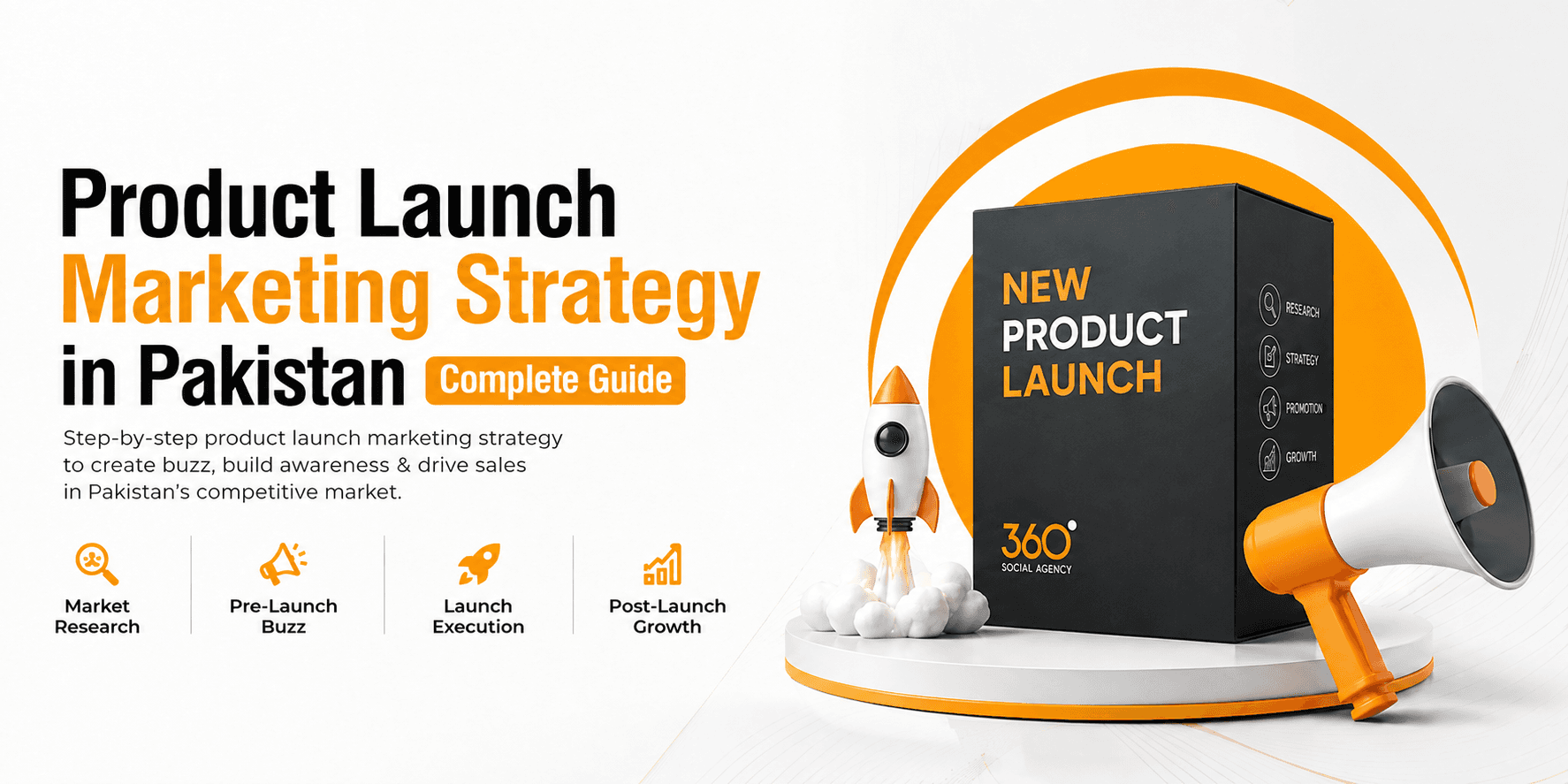
Launching a new product without proper planning can waste time, money and effort. A business may have a strong product, but if the right people do not know about it or understand its value, the launch can still fail.
A successful launch does not begin on the day the product becomes available. It starts earlier with market research, clear positioning, audience preparation, content planning and coordinated execution.
A product launch marketing strategy is a structured plan for introducing a new product, service or brand to the market. It helps a business decide who the target customers are, what problem the product solves, why people should choose it and which marketing channels should be used.
A complete launch strategy should answer five basic questions:
Who is the product designed for?
What customer problem does it solve?
Why is it different from existing options?
How will the product reach potential customers?
How will launch performance be measured?
For businesses in Pakistan, launch planning is particularly important because customer behaviour differs across cities, industries and price ranges. A restaurant launching in Multan may require a different strategy from a skincare brand in Karachi or a software company targeting businesses across Pakistan.
Start With Market Research
The first stage of a successful product launch is understanding the market. Before creating advertisements, hiring influencers or producing social media content, the business should study its competitors and potential customers.
Competitor research helps identify what similar brands are offering, how they communicate, what prices they charge and which platforms they use. It also reveals weaknesses that a new product may be able to address.
Businesses should examine:
Competitor products and services
Pricing and promotional offers
Customer reviews and complaints
Social media content
Advertising messages
Delivery and return policies
Areas where customer needs remain unaddressed
For example, customers using a food-delivery service may repeatedly complain about delayed orders, high delivery charges, limited restaurant choices or weak customer support. A new delivery service could use this information to build a more relevant offer.
Research should not be limited to publicly available information. Businesses should also speak directly with potential customers. Short surveys, interviews, focus groups and WhatsApp conversations can reveal what people actually want and whether they are willing to pay for the proposed product.
Many businesses make the mistake of developing a product based entirely on assumptions. They believe the idea will succeed because it sounds useful or attractive. However, market demand should be tested before a large amount of money is invested.
A Minimum Viable Product, commonly called an MVP, is a basic version of the product that includes only its most important features. A restaurant may test a limited menu, a clothing brand may release a small collection, and a software company may invite a selected group of users to test an early version.
Positive feedback is useful, but it does not automatically confirm product-market fit. Businesses should also study:
Repeat purchases
Customer retention
Product usage
Referrals
Willingness to pay
Refunds and complaints
These signals provide a more realistic picture of whether the product has long-term potential.
Create Clear Product Positioning
Once the market has been researched, the next step is deciding how the product will be presented. Product positioning explains how customers should view the product compared with other options in the market.
A strong value proposition should clearly communicate the main customer benefit. It should explain what the product does, who it helps and why it is worth choosing.
For example, the message “Fresh meals delivered within 20 minutes in selected areas of Lahore” is stronger than “We provide innovative food solutions.”
The first statement gives the customer a clear and measurable benefit. The second is vague and could apply to almost any food business.
The marketing message should focus on customer outcomes rather than only listing technical features. Instead of explaining only what the product contains, the business should explain how it saves time, solves a problem, improves comfort or provides better value.
The language used in the campaign should also match the target audience. Some premium and business-focused brands may communicate mainly in English. Mass-market brands may perform better with a combination of Urdu, Roman Urdu and English.
Pakistani customers often want clear information about:
Price
Delivery time
Cash-on-delivery availability
Product authenticity
Warranty
Return policy
Customer support
Availability in their city
These details should be addressed clearly during the launch campaign.
Develop a Go-to-Market Plan
A go-to-market plan explains how the product will reach its intended customer. It connects product development, marketing, sales and customer support so that every team works towards the same objective.
The first step is defining the ideal customer. A target audience should be more specific than “men and women between 18 and 45.”
A useful customer profile may include:
Location
Age range
Profession
Income level
Main problem
Buying habits
Preferred social platform
Factors influencing purchase decisions
For example, a medical scrubwear brand may target doctors, nurses, medical students and healthcare workers who need comfortable, durable and professional clothing. This is much clearer than targeting everyone interested in fashion.
The next step is selecting the right sales and marketing channels. Common launch channels in Pakistan include:
Instagram
Facebook
TikTok
WhatsApp
Brand websites
Daraz
Retail stores
Distributors
Direct sales teams
LinkedIn for B2B products
A skincare brand may rely on Instagram, its website and WhatsApp. A business software company may use LinkedIn, email outreach, product demonstrations and direct sales meetings. A restaurant may focus on Instagram Reels, TikTok, Facebook advertisements and local influencers.
The most popular platform is not always the best one. Businesses should choose channels based on where their customers search for information, compare products and make buying decisions.
A launch timeline is also essential. It should show when content will be created, when teaser posts will begin, when advertisements will run and how launch-day activity will be managed.
Build Pre-Launch Awareness
One of the most common launch mistakes is waiting until launch day to start marketing. Customers normally need repeated exposure before they become interested enough to make a purchase.
A pre-launch campaign creates curiosity and prepares the audience before the product becomes available.
Useful pre-launch content may include:
Countdown posts
Behind-the-scenes videos
Product close-ups
Founder stories
Packaging reveals
Problem-focused content
Staff preparation videos
Early customer reactions
The goal is not to reveal everything at once. Each piece of content should gradually introduce the product and give the audience a reason to follow the campaign.
A waitlist can also help identify serious potential customers. Businesses can create a simple landing page where people enter their name, email address or WhatsApp number.
Customers may be encouraged to join through:
Early access
Limited discounts
Free delivery
Priority reservations
Exclusive launch invitations
This allows the business to communicate directly with interested customers instead of relying entirely on social media reach.
Pre-launch content should also educate the audience. It should explain the problem the product solves, how it works, who it is for and what makes it different. By launch day, potential customers should already understand the offer.
TSO Restaurant Launch Case Study
The TSO restaurant campaign provides a practical example of pre-launch audience building. The restaurant did not have an existing customer base before opening, so the campaign focused on generating anticipation in advance.
The strategy included:
Story-driven content for engagement
Targeted paid advertising
Audience warming through pre-launch funnels
Frequent content across social platforms
Launch-day ad optimization for walk-ins
According to the campaign results, the restaurant achieved a full house on launch day. The campaign also generated strong conversion from paid advertising and helped maintain sales momentum after opening.
This case shows that a restaurant launch should not depend only on food quality or location. Customers must first know the restaurant exists, understand what makes it different and have a reason to visit.
Execute the Launch Across Multiple Channels
Launch execution is the stage where planning becomes visible to the public. Advertising, content, sales and customer experience must work together.
The campaign should appear consistent across Instagram, Facebook, TikTok, WhatsApp, email, the website and physical branding. The format may change between platforms, but the main message and offer should remain consistent.
Paid advertising can increase awareness, but it cannot fix unclear positioning or a weak offer. Before increasing the advertising budget, businesses should test different campaign elements.
These may include:
Headlines
Video openings
Static and video creatives
Audience groups
Benefit-based messages
Promotional offers
Calls to action
The early campaign results can show which creative, audience or message is performing best. The business can then allocate more budget to advertisements generating meaningful actions such as enquiries, reservations, leads or purchases.
For physical businesses, the launch-day experience can also become part of the marketing strategy. A memorable event encourages customers to record videos, share stories and recommend the business to others.
This user-generated content often feels more authentic than content published directly by the brand.
Kwisp Restaurant Launch Case Study
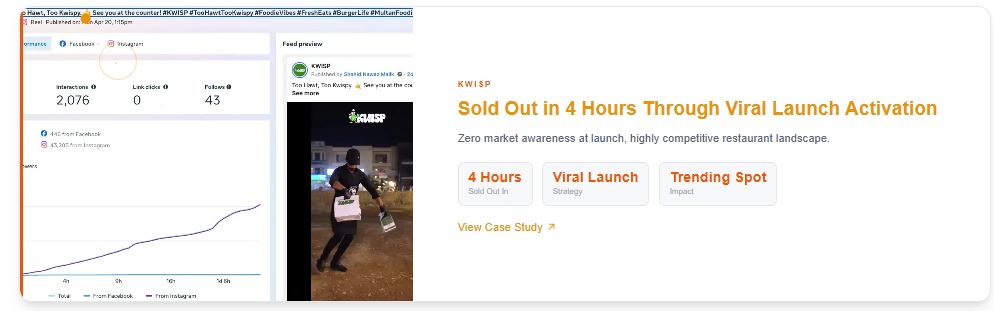
The Kwisp restaurant launch demonstrates how an on-ground experience can support digital marketing. The restaurant entered a competitive market with limited existing awareness, so the campaign needed to attract attention quickly.
The launch strategy included:
A live drum-circle activation
A pre-planned short-form video strategy
Launch-day content created for maximum shareability
Organic user-generated content stimulation
Coordinated social media publishing
Multi-angle video recording for Reels and TikTok
According to the available campaign evidence, Kwisp sold out within four hours of opening. The launch also generated strong organic social media traction and helped position the restaurant as a trending dining destination.
The activation was not random entertainment. It was planned as part of the wider content and marketing strategy. The physical experience attracted people at the location, while the digital content helped that experience reach a larger online audience.
Measure Performance After Launch
A product launch does not end when the product becomes available. The business must review the results and understand what worked.
The most relevant metrics depend on the business model.
An online store may track:
Website traffic
Conversion rate
Cost per purchase
Average order value
Cart abandonment
Repeat purchases
A restaurant may monitor:
Reservations
Walk-ins
Cost per message
Customer reviews
Average bill value
Repeat visits
A software company may track:
Sign-ups
Activation rate
User retention
Paid conversions
Customer-acquisition cost
Churn rate
Likes, views and followers can help measure awareness, but they should not be treated as the only signs of success. A campaign may generate thousands of views without producing meaningful sales.
Customer feedback is equally important. Reviews, surveys, social media comments, support messages and direct customer conversations can explain why people purchased the product and what they disliked.
This information should be used to improve the product, pricing, marketing message and customer experience.
Conclusion
A successful product launch marketing strategy in Pakistan requires research, clear positioning, audience preparation and coordinated execution.
The process begins with understanding the market and testing whether customers genuinely need the product. The business must then create a clear value proposition, define its target audience and select the most relevant marketing channels.
Pre-launch content helps build curiosity before the product becomes available. During the launch, advertising, social media content and customer experience should work together. After launch, performance data and customer feedback should guide further improvements.
The TSO and Kwisp campaigns demonstrate two different but effective restaurant launch approaches. TSO used pre-launch audience warming and paid advertising to achieve a full house on launch day. Kwisp combined an on-ground activation with shareable short-form content and sold out within four hours.
Both cases support the same lesson: launch-day results are usually created before launch day through research, planning, audience preparation and consistent marketing.
Frequently asked questions
A product launch marketing strategy is a structured plan for introducing a new product or service to the market. It covers target audience research, positioning, promotional channels, launch activities and performance measurement.
For a small or local business, launch marketing should usually begin three to six weeks before the official launch. Larger products may require several months of research, testing and audience building.
The best platform depends on the target audience. Instagram, Facebook and TikTok work well for visual and consumer products, while LinkedIn and email are more suitable for B2B services. WhatsApp is useful for enquiries, follow-ups and direct sales.
There is no fixed launch budget for every business. Start with a controlled testing budget, compare different audiences and creatives, and increase spending only on campaigns generating enquiries, reservations or sales.
Pre-launch marketing creates awareness and curiosity before the product becomes available. It gives potential customers time to understand the offer, follow the brand and prepare to purchase on launch day.
Want us to do this for you?
Get a free, no-pressure audit of your ads, funnel, and website.
Get my free auditKeep reading

Admission Marketing Strategy for Private Schools in Pakistan: From Awareness to Enrollment
7 min read
SEO for Restaurants in Karachi: How Restaurants Can Attract More Customers Online
6 min read
Why Lahore Businesses Need Performance Marketing Services to Grow Online
8 min read