The Psychology of Digital Trust: Why People Buy From Brands They Believe

A customer visits your website, sees your product, checks your social media, reads a few reviews and then leaves. Why?
Sometimes the price is not the problem. The product may be exactly what they need. The real problem is trust.
In today's digital marketplace, customers have countless options. Before buying, they look for signals that tell them a brand is reliable, professional, and capable of delivering what it promises.
That is where digital trust comes in.
Digital trust is not created by one advertisement or one impressive website. It develops through every interaction a customer has with your brand—from the first Google search to social media, website experience, reviews, communication, and ultimately the buying experience.
What Is Digital Trust?
Digital trust is the confidence customers have that a brand will deliver what it promises.
Think about ordering from an unfamiliar online store. Before entering your payment details, you might check the following:
Customer reviews
Website quality
Social media activity
Contact information
Return or refund policies
Previous customer experiences
Brand reputation
You are not simply evaluating the product.
You are evaluating the risk of trusting the company behind it.
Edelman's 2025 Brand Trust research found that trust is a major factor in brand purchase decisions, with 88% of respondents considering trust important or a deal breaker when deciding which brands to buy or use.
This shows that trust is not just a branding concept. It directly influences purchasing behaviour.
Why Do People Trust Some Brands More Than Others?
Trust is strongly connected to psychology.
Customers naturally look for signals that reduce uncertainty and make a decision feel safer. Several factors play an important role.
1. Familiarity Creates Confidence
Imagine seeing a brand for the first time compared with seeing the same brand repeatedly across Google, Instagram, LinkedIn, and its website.
The second brand feels more familiar.
Consistent branding, messaging, and communication help customers recognise a business and understand what it represents.
This does not mean posting content simply for the sake of visibility.
It means creating a consistent digital identity.
Your website, advertisements, social media, and content should feel like different parts of the same brand not completely different businesses.
2. Social Proof Reduces Risk
People often look at other people's experiences before making a decision.
That is why reviews, testimonials, ratings, case studies, and user-generated content are powerful.
Consider two agencies.
One says:
“We provide the best marketing services.”
The other shows:
Client projects
Testimonials
Case studies
Campaign examples
Measurable results
Industry experience
The second agency provides something much more valuable than a claim:
Evidence.
Social proof reassures potential customers that others have already trusted the business.
For brands, genuine customer feedback is therefore not just something to display on a website. It is a valuable marketing asset.
3. Evidence Is Stronger Than Empty Claims
Digital audiences see phrases such as “best quality", “number one", and “industry-leading” every day.
The problem is that anyone can make these claims.
A trustworthy brand demonstrates its expertise instead.
Instead of saying:
“We are experts.”
Show it.
Publish useful insights. Explain your process. Share real work. Answer customer questions. Present case studies. Demonstrate your knowledge.
This approach also supports Google's emphasis on helpful, reliable, people-first content that demonstrates genuine expertise and value.
The principle is simple:
Don't just tell people why they should trust you. Give them reasons to.
4. Professional Design Shapes Perception
Before customers read your message, they see your brand.
Your website design, social media graphics, photography, videos, typography, and overall visual identity create an immediate impression.
A confusing website can create doubt.
Poor-quality visuals can make a professional service appear less credible.
Inconsistent branding can make an established company look inexperienced.
This does not mean every business needs an expensive website.
It means the digital experience should reflect the level of professionalism you want customers to associate with your business.
Design communicates before words do.
5. Transparency Builds Confidence
Customers feel more comfortable when they know what to expect.
Clear information reduces uncertainty.
A trustworthy brand should make it easy to understand:
What it offers
How the process works
What it costs, where appropriate
How customers can contact the business
What happens after purchase
What customers can realistically expect
Transparency does not mean revealing everything about your business.
It means removing unnecessary doubt.
When uncertainty decreases, confidence increases.
6. Human Communication Still Matters
One of the biggest mistakes brands make online is sounding too corporate or automated.
Customers want clear answers, useful information, and communication that feels human.
This is particularly important as AI-generated content becomes increasingly common.
AI can help businesses produce content faster, but speed does not automatically create credibility.
Customers still value originality, experience, empathy, and genuine understanding.
The brands that stand out will not necessarily be those publishing the most content.
They will be those creating content that actually helps people.
Trust Is Built Across the Customer Journey
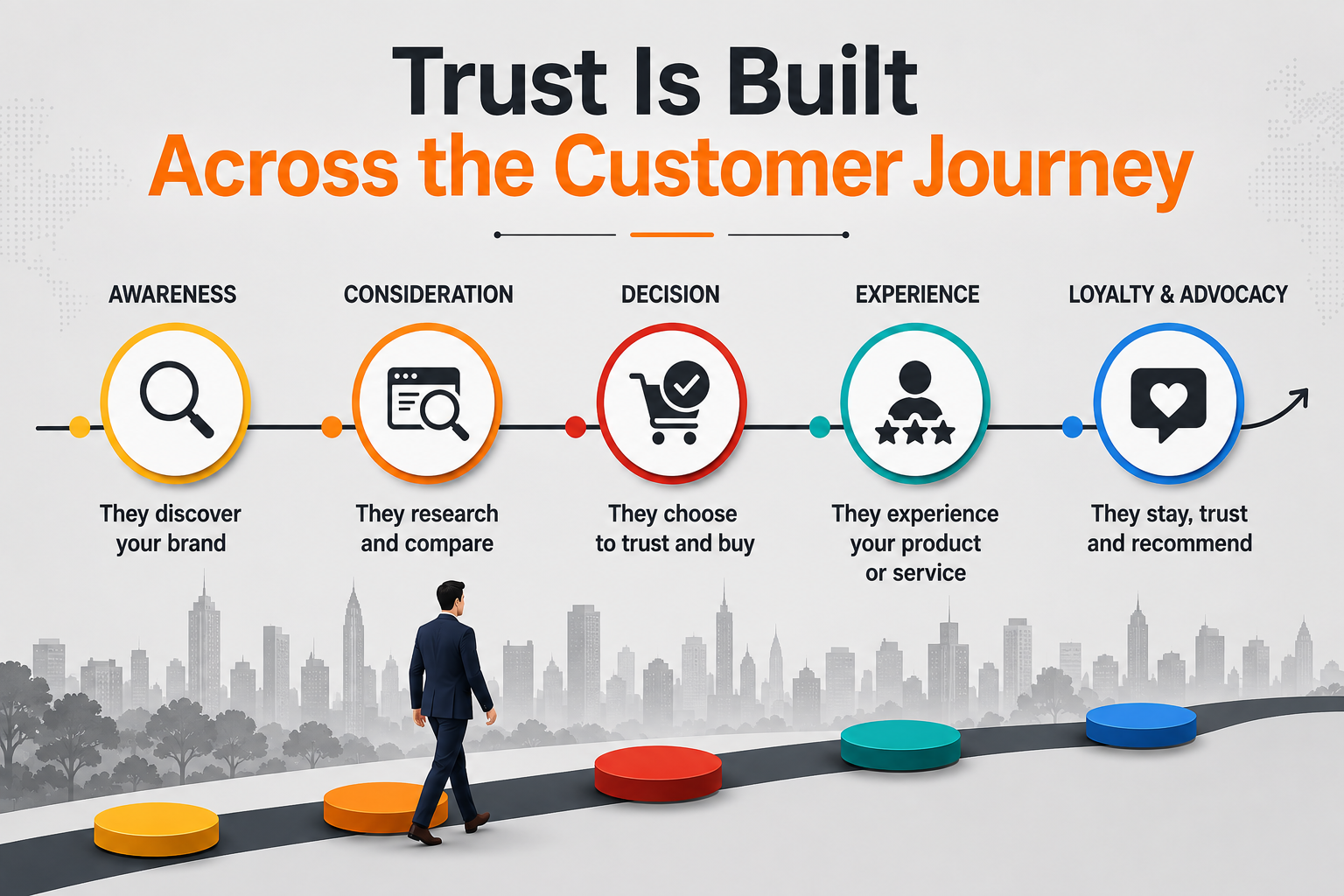
A customer rarely decides whether to trust a brand after seeing one post.
Trust develops through multiple touchpoints.
A customer might:
Search on Google → See your social media → Visit your website → Read reviews → Contact you → Purchase → Experience your service
Every step matters.
SEO can help customers discover you.
Social media can build familiarity.
Content can demonstrate expertise.
Advertising can create awareness.
A professional website can turn interest into action.
Customer service can strengthen the relationship.
These are not separate experiences.
Together, they form the customer's perception of your brand.
That is why effective digital marketing should focus on the entire customer journey, not just individual campaigns.
How Can Businesses Build Digital Trust?
Building trust takes time, but the fundamentals are straightforward.
Be consistent
Keep your branding, message, and communication consistent across platforms.
Show real work
Use genuine projects, case studies, testimonials, and examples instead of relying only on promotional claims.
Educate before selling
Helpful content allows customers to experience your expertise before they become buyers.
Make your website credible
Provide clear information, professional design, easy navigation, and accessible contact details.
Encourage genuine reviews
Real customer experiences can provide powerful reassurance to new customers.
Communicate like a human
Respond to questions and feedback thoughtfully instead of treating every interaction as a sales opportunity.
Keep your promises
Ultimately, the strongest trust-building strategy is simple:
Do what you said you would do.
The Future of Digital Trust

The digital environment is becoming more crowded, automated, and competitive.
Customers are exposed to enormous amounts of content every day. At the same time, AI is changing how people search for information, discover brands, and make decisions.
In this environment, visibility alone is not enough.
A business can generate traffic and still struggle to convert it.
The missing ingredient may be trust.
The question businesses need to ask is no longer simply the following:
“How can we get more people to see us?”
It should also be:
“When people see us, do they have enough reasons to believe us?”
That shift can completely change how a brand approaches digital marketing.
Final Thoughts
People do not buy simply because a brand is visible.
They buy when they feel confident that the brand understands their needs, delivers on its promises, and provides a reliable experience.
That confidence is built through consistency, social proof, expertise, transparency, professional design, and human communication.
At 360 Social Agency, we see digital marketing as more than generating clicks or increasing followers. SEO, social media, performance marketing, content, branding, and websites should work together to create a digital experience that customers can trust.
Because the strongest brands are not simply the ones people notice; they are the ones people believe.
Frequently asked questions
Digital trust is the confidence customers have that a brand is reliable, transparent, secure, and capable of delivering what it promises online.
Reviews, testimonials, ratings, case studies, and genuine customer experiences provide evidence that other people have successfully interacted with a brand
Yes. When customers feel confident about a brand, they may be more comfortable making a purchase and developing a long-term relationship with the business.
Useful, accurate, and relevant content demonstrates knowledge and helps customers understand that a business can provide genuine value rather than simply trying to sell something.
Digital trust reduces customer uncertainty and can influence whether people choose to engage with, purchase from, and recommend a brand.
Want us to do this for you?
Get a free, no-pressure audit of your ads, funnel, and website.
Get my free audit